
Role of Photosensitizers in Photodynamic Therapy of Cancer Treatment: A Comprehensive Review
DOI:
https://doi.org/10.5530/gjpb.2025.4.11Keywords:
Photodynamic therapy, Photosensitizers, Cancer treatment, Reactive oxygen species, Tumor targeting, nanotechnologyAbstract
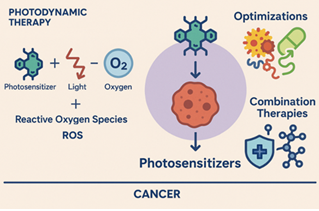
Photodynamic therapy (PDT) is a clinically approved, minimally invasive treatment that uses a photosensitizer (PS), a specific wavelength of light, and molecular oxygen to induce localized cytotoxic effects in cancerous tissues. Upon light activation, the photosensitizer generates reactive oxygen species (ROS), particularly singlet oxygen, leading to oxidative damage, apoptosis, or necrosis of tumor cells. The effectiveness of PDT is critically influenced by the properties of the photosensitizer, including its absorption spectrum, photostability, tumor selectivity, and pharmacokinetics. Over the years, photosensitizers have evolved from first-generation compounds, which suffered from poor specificity and prolonged skin photosensitivity, to second- and thirdgeneration agents with enhanced light absorption, reduced toxicity, and tumor-targeting capabilities. Recent innovations focus on nanotechnology-based delivery systems, targeted conjugates, and photoactivatable prodrugs to overcome current limitations such as non-specific accumulation, limited light penetration, and tumor hypoxia. Moreover, the combination of PDT with emerging therapies such as immunotherapy and molecular-targeted treatments is being actively explored to achieve synergistic effects and long-term tumor control. With ongoing advances in molecular design, imaging integration, and bioengineering, PDT is being refined as a more precise and effective tool in the oncologist’s arsenal. This review provides a detailed examination of the central role of photosensitizers in PDT, including their mechanisms of action, classifications, challenges in clinical implementation, and the latest strategies to optimize their performance in cancer treatment.
Metrics
Downloads
Published
How to Cite
Issue
Section
License
Copyright (c) 2026 Selvakumar Muruganantham

This work is licensed under a Creative Commons Attribution 4.0 International License.


